
The Forecast That Forecasts Nothing
Once a quarter a company agrees on a forecast its own leadership privately discounts. Then it staffs, spends, and plans against it anyway.

A CFO will tell you the forecast is accurate within five percent. The CRO will agree. The board will be shown a single line waterfall that treats the commit number as a near certainty. And yet if you sat those same three people down separately and asked each to stake personal capital on the outcome, you would get three different numbers, none of which matches what was presented.
The analytics have never been better. Pipeline tools have multiplied, AI scoring overlays are standard, conversion data is captured at a level of granularity that would have been unimaginable a decade ago, but accuracy has not improved in proportion. In some segments, it has gotten worse.
The forecast, at most mid to large companies, has gone from a prediction to a negotiation.
Only 45 percent of sales leaders report high confidence in their own forecast, according to Gartner’s 2024 sales operations research.
Median forecast accuracy across B2B organizations sits near 47 percent, per benchmarks published by Ebsta and Pavilion.
Roughly two-thirds of surveyed sales leaders admit to systematic sandbagging in at least one quarter of the fiscal year (RevOps Co-op, 2024).
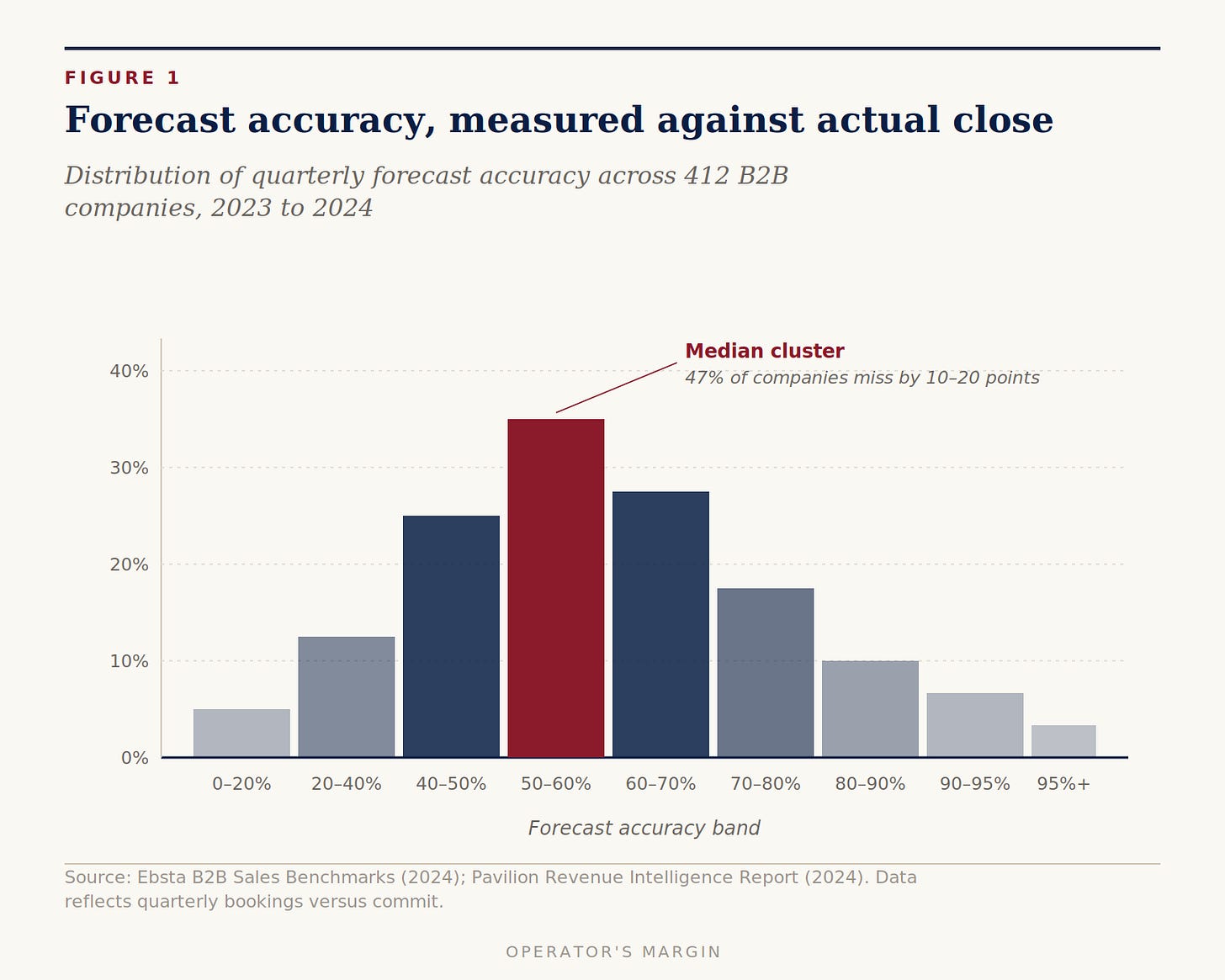
Whats producing this distortion is not dishonesty, but the incentive architecture around the number itself.
A sales leader who hits 101% of commit is a hero. A sales leader who hits 99% is a disappointment. The asymmetry of that reaction, compounded over a career, teaches a lesson that the commit is not the best estimate of the future, it is the estimate you are most certain you can exceed. The forecast becomes a floor, not a prediction. Every layer above the frontline then adjusts. Finance shaves a little, the COO shaves a little more, the CEO shaves again before it reaches the board. By the time a number has been politically sanitized four times, it describes nothing real.
The problem is that the rest of the company does not know this. Or rather, it knows it in the abstract and ignores it in practice. Capacity planning is run against the sanitized number. Inventory commitments are made against it. Headcount approvals are made against it. Marketing spend is ramped against it.
The second order cost
An inaccurate forecast carries two costs. The first is the miss itself, the visible number that dominates the debrief. The second is larger: the chain of operating decisions made on the belief that the forecast was real.
Take a company that sandbags by 12% a quarter. Sustained over a year, that is a structural mis-sizing of the business. Each beat reads as demand, so the company hires against a run rate that was never going to hold. Sandbag buffers cannot grow forever. When the beat finally compresses, revenue reverts to trend and the company is left with a cost base built for a run-rate that no longer exists.
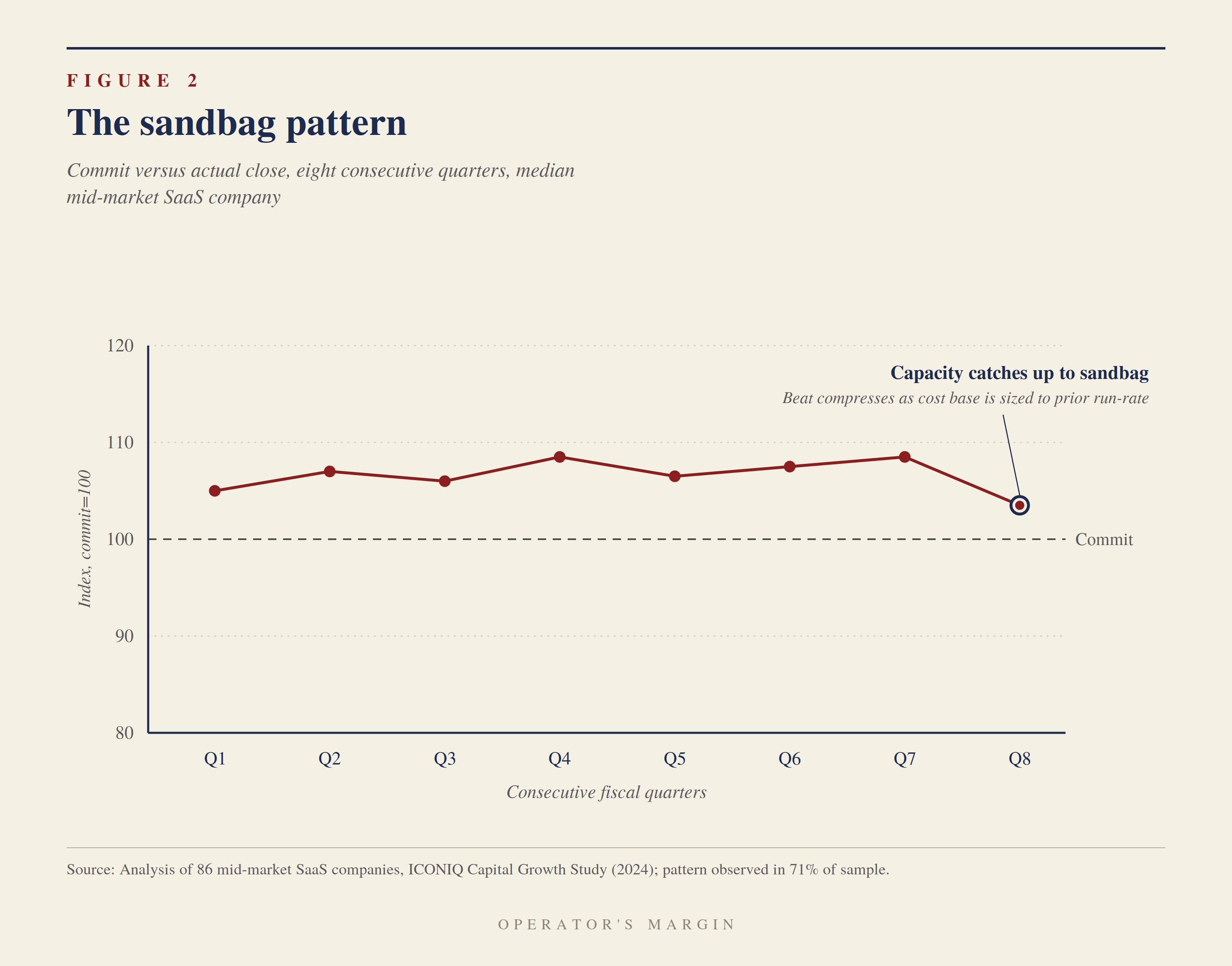
The final quarter in Figure 2 is where it gets interesting. The beat compresses because the organization has hired, spent, and committed against prior beats as if those beats represented underlying demand. The cost base rises to the exaggerated run rate, the revenue line reverts to trend, and the margin takes the difference.
None of this shows up in the forecast review. The forecast review treats each quarter’s miss as a discrete event: sales execution, a deal slip, a macro headwind. The structural pattern (that the company is making decisions against a number that was engineered to be beaten) does not surface. It cannot surface, because acknowledging it would require the sales leader to raise the commit, which would eliminate the beat, which would eliminate the professional reward for forecasting.
The forecast is wrong because no one has asked it to predict the future.
What the best operators do differently
The companies that produce genuinely useful forecasts tend to share three structural traits.
First, they separate the commit from the plan. The commit is what sales is willing to stand behind. The plan is the honest expected value. These are different numbers and they are allowed to be different. Finance operates against the plan. The board sees both. Nobody is asked to pretend they are the same.
Second, they measure forecast accuracy as a leadership KPI in its own right, with penalties for over attainment as well as under. A leader who beats by 15% has not performed well, they have forecasted badly. Treating this as a failure, not a triumph, changes the incentive.
Third, they treat the forecast call as a diagnostic rather than a commitment. The question in the room is not “can you hit the number,” it is “what would have to be true for this number to be correct, and how confident are we in each of those things.” The output is a distribution instead of a point estimate.
These are unglamorous practices. But they are the difference between a forecast that informs the business and a forecast that the business quietly works around.
A forecast that everyone privately disbelieves is not a forecast. It is a ritual. And rituals, unlike forecasts, are extremely hard to improve, because improvement is not what they are for.